If you are working out how to start an online travel agency, you need five things in place: a clear niche, a registered and properly licensed business, contracts with flight and hotel suppliers, a way to collect payments, and a booking website that can sell around the clock. The order matters, because suppliers and payment providers will ask for your registration documents before they give you live access. This guide walks through each stage so you can plan the work, the budget and the timeline realistically.
What an online travel agency actually does
An online travel agency (often shortened to OTA) sells travel products such as flights, hotel rooms, tours, visas and holiday packages through a website instead of, or alongside, a high-street office. The agency rarely owns the inventory. Instead it connects to suppliers who hold the seats and rooms, adds its own margin or service fee, and handles the customer relationship from search to after-sales support.
That means your real product is not the hotel or the airline seat. It is the experience of finding, comparing and booking them with confidence, plus the service you give when plans change. Keeping that in mind will shape every decision below, from which niche you pick to which technology you buy.
Step 1: Choose a niche and a business model
Trying to sell everything to everyone is the fastest way to burn a marketing budget. Large global brands already dominate generic searches for cheap flights and hotels, so a new agency needs a sharper focus. Good niches tend to combine a specific audience with a specific type of trip.
- Religious travel, such as Umrah packages, where customers value trust, guidance and complete packages over the lowest headline price.
- Regional routes you know well, for example travel between your country and a large diaspora community abroad.
- Corporate and group travel, where accuracy, invoicing and account management matter more than flashy design.
- Holiday packages and tours to destinations where you have local partners and first-hand knowledge.
- Visa-led services, where helping people with documentation becomes the entry point to selling flights and hotels.
You also need to decide who buys from you. A business-to-consumer (B2C) agency sells directly to travellers. A business-to-business (B2B) agency supplies other travel agents, who then sell to their own customers. Many agencies end up doing both. If you are unsure which route fits, our comparison of B2B vs B2C travel portals explains the trade-offs in detail.
Step 2: Register the business and get the right licences
Travel is a regulated activity in most countries. Before you can sign supplier contracts or open a merchant account, you will usually need a registered company, a tax registration and a travel agency licence from the relevant tourism authority. Requirements vary by country and sometimes by province or state, so check with the authority that covers the place your company is registered.
IATA accreditation or a consolidator
To issue airline tickets in your own name, agencies typically need IATA accreditation, which allows them to settle with airlines through the Billing and Settlement Plan (BSP) in their market. Accreditation involves financial checks and often a bank guarantee, which can be a heavy commitment for a new business. Many new agencies therefore start by working with a consolidator: an accredited agency that issues tickets on your behalf in exchange for a fee or a share of the commission. You can apply for your own accreditation later once your volume justifies it.
Step 3: Secure flight, hotel and other supplier content
Your website is only as good as the inventory behind it. Suppliers fall into a few broad groups, and most agencies combine several of them.
- Flights usually come from a global distribution system (GDS) such as Amadeus or Sabre, or from an aggregator such as Duffel that connects to airlines directly. Our guide to Amadeus API integration explains what that process involves.
- Hotels typically come from bedbanks and wholesalers such as Hotelbeds, WebBeds or Agoda, which give you access to large inventories at net rates you can mark up.
- Tours, transfers and activities often come from local partners you contract directly, loaded into your system manually.
- Visas are a service rather than an inventory: you sell the processing and handle documents with the relevant embassy or online portal.
Every supplier has its own onboarding. Expect a commercial agreement, a credit check or deposit for some, test credentials for a sandbox environment, and a review or certification step before you receive live credentials. Make sure every contract and every set of API credentials is issued in your company's name, not in the name of a developer or software provider. That keeps the commercial relationship, and the ability to switch technology later, firmly with you.
Step 4: Choose your booking technology
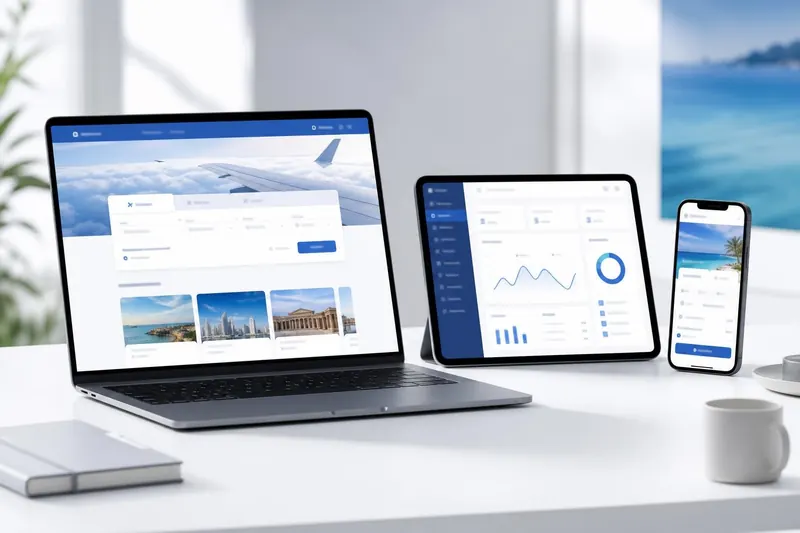
The booking platform is the engine of an online travel agency. It searches your suppliers, displays results, applies your markups, takes payment, creates the booking with the supplier and sends confirmations. You have three realistic options.
| Option | How it works | Main advantage | Main drawback |
|---|---|---|---|
| Build from scratch | Hire developers to design and code your own platform and integrations | Total control over every feature | Long timeline, high cost and ongoing maintenance of every supplier connection |
| Monthly subscription | Rent a hosted platform and pay a recurring fee, sometimes plus a per-booking charge | Quick to start with low upfront cost | Costs grow with your success and you rarely own the code or data |
| One-time licence | Buy a white-label platform once and install it on your own domain and server | Predictable cost with ownership of the source code | You manage hosting and need some technical help for changes |
Building from scratch rarely makes sense for a new agency because the first year should be spent selling, not debugging supplier connections. Our article on build vs buy travel booking software goes deeper into the numbers you should compare. Whichever route you choose, check that the platform supports the modules your niche needs, works well on mobile, lets you set your own markups and keeps supplier credentials in your name.
Step 5: Set up payments, pricing and markups
Most suppliers give you net rates, and your profit comes from what you add on top. Decide early how you will price: a fixed service fee per booking, a percentage markup, or a mix that varies by product, route or customer type. Be consistent and transparent, because travellers compare prices across many sites before they buy.
On the payment side, you will need at least one card payment gateway and, in many markets, bank transfer as an alternative. Gateways will ask for your company documents, licence and website before approving you, and some treat travel as a higher-risk category because of the gap between payment and travel date. Allow time for that review. If you plan to sell to other agents, a prepaid wallet they top up in advance is a common way to manage B2B payments safely.
Step 6: Plan operations and customer support
Selling the booking is half the job. The other half is everything that happens afterwards, and this is where online agencies win or lose their reputation. Write down how you will handle each of these before you go live:
- Ticketing deadlines, so that booked flights are issued before the airline cancels the reservation.
- Cancellations, refunds and date changes, including which supplier rules apply and how long refunds take.
- Failed or pending bookings, where payment succeeded but the supplier did not confirm.
- Customer communication by email, phone and messaging apps, with clear opening hours or an out-of-hours process.
- Terms and conditions, a privacy policy and a refund policy written for your own market.
Step 7: Market the agency and launch
A new travel website will not attract visitors on its own. Combine a few channels rather than relying on one. Search engine optimisation brings steady traffic over time, especially for niche pages such as specific routes, packages or destinations. Social media and messaging apps work well for promotions and repeat customers. Partnerships with community groups, mosques, universities or companies can deliver group bookings that would be hard to win through ads alone.
Before you announce the launch, run real test bookings end to end with small amounts. Check the confirmation emails, the supplier reference, the invoice and the refund process. Fixing a problem with one test booking is far cheaper than fixing it after fifty customers have paid.
How to start an online travel agency: a launch checklist
- Define your niche, target customers and whether you will sell B2C, B2B or both.
- Register the company, obtain tax registration and apply for the travel agency licence your market requires.
- Decide between IATA accreditation and a consolidator for ticketing.
- Sign supplier agreements for flights and hotels, with credentials in your company's name.
- Choose and install your booking platform on your own domain.
- Apply for payment gateways and set up bank transfer details.
- Configure markups, currencies, languages and email templates.
- Write your terms, privacy and refund policies.
- Complete end-to-end test bookings for every product you sell.
- Launch with a focused marketing plan and review results weekly.
Budget for each of these separately. Hosting, supplier deposits, gateway fees and licence costs are ongoing commitments that sit alongside your technology spend, so build them into your cash-flow plan from day one.
Next steps
If you have your niche and licensing underway, the next decision is the platform. The TravelBookingPanel is a white-label travel booking panel sold on a one-time licence with full source code, installed on your own domain and server, with modules for flights, hotels, Umrah, tours and visas. There is no monthly fee and no booking commission. Compare the plans on our pricing page or contact our team to talk through your launch plan.
Frequently asked questions
Can I start an online travel agency without IATA accreditation?
Yes. Many new agencies start by working with a consolidator, an accredited agency that issues airline tickets on their behalf. You can still sell flights, hotels and packages through your own website and apply for your own accreditation later when your volume justifies the financial commitment.
How long does it take to launch an online travel agency?
It depends mostly on paperwork rather than technology. Company registration, licensing, supplier onboarding and payment gateway approval can each take weeks. Installing a ready-made booking platform is usually the quicker part, so start the legal and supplier processes as early as possible.
Do I need to know how to code to run an online travel agency?
No. With a ready-made booking platform you manage markups, content, bookings and customers through an admin back office. Some technical help is useful for hosting, domain setup and any custom changes, but day-to-day operation does not require coding.
Which products should a new online travel agency sell first?
Start with the products your niche needs most and that you can support well. For many agencies that is flights and hotels, with packages, tours or visas added once the core booking and after-sales processes are running smoothly.
Who should own the supplier contracts and API credentials?
Your agency should. Contracts and credentials in your company's name keep the commercial relationship with you and let you change software providers in future without losing access to your suppliers.